 Winter Haven Golf Cart Repair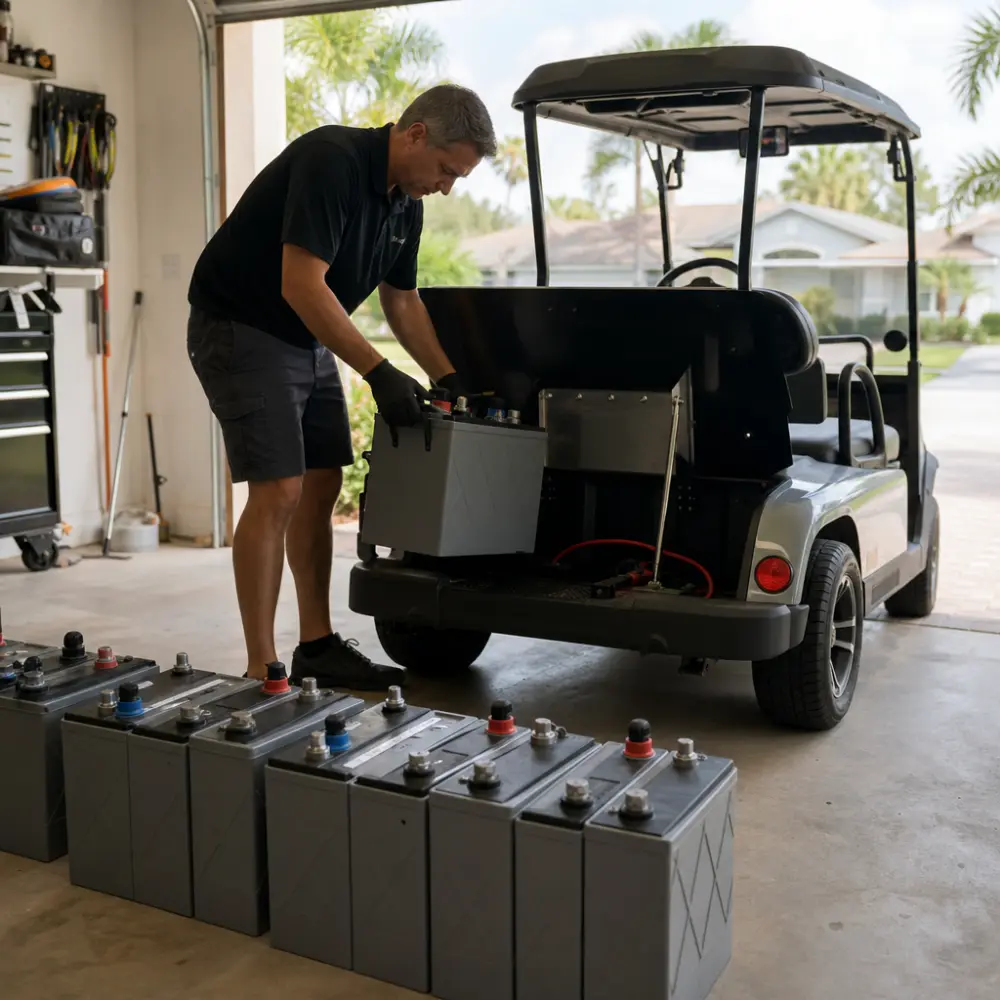
Winter Haven Golf Cart Repair sends a technician to your driveway, garage, or cart barn anywhere in Winter Haven and the surrounding Chain of Lakes towns and fixes your cart on-site: batteries, brakes, tires, chargers, solenoids, motors, controllers, and lights. A full lead-acid battery pack runs $1,200 to $1,800 installed, brake work $75 to $400, tires $75 to $150 each, and the $50 to $100 service call is applied toward your repair. Describe the symptom by form and we usually arrive with the likely parts already on the truck.
Winter Haven earned the nickname “Chain of Lakes City” honestly: the city holds 50 lakes, a northern chain of nine interconnected lakes and a southern chain of sixteen more connected by canals, and since 2011 a lock system has joined the two chains after six years of construction. The city sits at the headwaters of the Peace River and grew up on citrus, with packer John A. Snively running one of the largest fruit-packing operations in the world here through the 1930s and 40s. A cart town grows up around water and citrus groves the same way it grows up around a golf course: short trips, private roads, garages built for a car, and a cart that is expected to run every week of the year. When it will not, the diagnosis has to come to the driveway, and that is the whole reason this service is mobile.
What we fix, at your home
- Mobile golf cart repair: the core service. On-site diagnosis and repair of whatever is wrong: will not move, will not charge, weak on the way back from the lake, clicking, cutting out. All major brands, electric and gas.
- Battery replacement: new lead-acid packs installed with haul-away of the old cores, plus honest lead-acid versus lithium math for carts that run every day of the year.
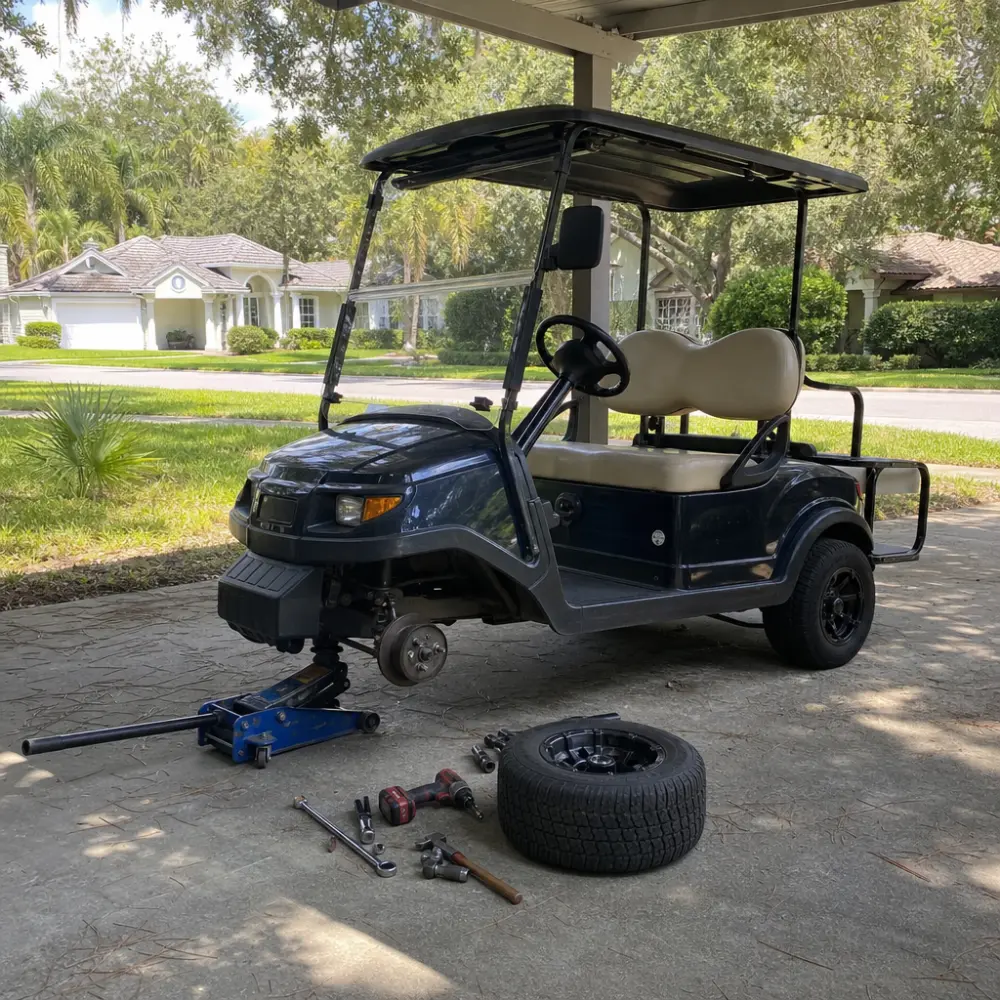
- Brakes and tires: adjustments, shoes, drums, and new tires installed in your driveway.
- Motor and controller repair: solenoids, speed controllers, and drive motors diagnosed with meters before anything gets replaced.
- Charger repair: carts that “will not take a charge” are often a charger, charge port, or corroded connection, not a battery problem. We test before we sell you anything.
- Tune-up service: the Chain of Lakes annual: battery water and load test, terminal cleaning, brakes, tires, lights, and a corrosion check tuned to a humid lake-country garage.
- Lights and street-legal equipment: headlights, brake lights, signals, mirrors, and reflectors installed to what F.S. 316.212 actually requires.
Full ranges for everything are published on the pricing page. Competitors make you call for a number. We would rather you see it first.
Why Polk County carts break the way they do
Heat is the battery killer, and it runs hotter here than most of the state. NOAA’s 1991 to 2020 climate normals for the Winter Haven station put the July average high at 92.8°F and August at 92.2°F, and count 114.7 days a year at 90°F or above, well over three months of the calendar. Inside a flooded lead-acid battery, heat evaporates water out of the electrolyte faster, and once the level drops below the top of the plates the exposed lead sulfates and permanently loses capacity. Heat also raises self-discharge, so a cart that sits two weeks in a closed garage in July comes back lower than it left. A pack rated for five or six years of northern golf-course duty often taps out at three or four here. Watering on a schedule from May through September is the cheapest thing you can do for a $1,200 pack.
The wet season is long and it does not let anything dry. Winter Haven’s annual precipitation normal is 51.95 inches, and roughly 30 of those inches, about 58 percent, fall June through September. Garages near the lakes stay damp for a third of the year. Terminals, cable lugs, and charge-port contacts oxidize, corroded connections add resistance, resistance mimics a dying battery pack, and owners end up shopping for $1,200 in batteries when the real fix is a $100 cable-and-terminal service. Part of every diagnostic is a voltage-drop check along the main cables.
Storm season changes the job. Hurricane Ian in September 2022 put Polk County among the counties north of its track, along with Charlotte, Sarasota, Hardee, DeSoto, and Manatee, that saw significant flooding when the Peace River crested to record levels, the same river whose headwaters sit inside Winter Haven. Hurricane Milton in October 2024 brought sustained wind of 49 knots and a gust to 76 knots at Winter Haven’s own Gilbert Field, with 4.60 inches of rain recorded there and 13.13 inches at Lakeland’s airport, plus a statewide outbreak of 45 tornadoes. Ahead of forecast weather we prioritize charger and battery calls, because a fully charged cart matters most when the power goes out. Afterward we see the other side: carts near the canals and lakeshores with water in the battery compartment, and inland, chargers that took a surge when the power came back.
The ground and the lakes both matter for corrosion and access. Winter Haven sits at an average elevation of 161 feet with lake after lake threaded through the street grid, so plenty of carts here live within a short walk of open water and the humidity that comes with it. That is a different corrosion pattern than a purely inland town, and it is why terminal care and cable checks are part of every visit, not an upsell.
Golf cart or LSV: the 20 mph line
Florida Statute 320.01(22) defines a golf cart as a vehicle built for a golf course that is “not capable of exceeding speeds of 20 miles per hour,” and 320.01(41) defines a low-speed vehicle as a four-wheeled vehicle whose top speed is “greater than 20 miles per hour but not greater than 25 miles per hour.” That number decides your rulebook.
A golf cart under F.S. 316.212 may be driven only on county roads or municipal streets that the county or city has designated for carts, sunrise to sunset unless the local government allows night driving and the cart has headlights, brake lights, turn signals, and a windshield. It must carry efficient brakes, reliable steering, safe tires, a rearview mirror, and red reflectors front and rear. A driver under 18 needs a learner’s permit or licence; a driver 18 or older must carry government-issued photo ID.
We looked for a City of Winter Haven ordinance or a Polk County designation of any public street for golf carts and could not find one. Until one exists, a sub-20-mph cart in Winter Haven and the surrounding towns stays on private property and community roads, where the community’s own rules apply. Inside Lake Ashton, the gated 55-plus community six miles south of downtown, the two golf courses and internal roads carry the daily cart traffic.
A low-speed vehicle under F.S. 316.2122 is a titled, registered, insured motor vehicle allowed on any street posted 35 mph or less, with headlamps, stop lamps, turn signals, taillamps, reflectors, parking brake, mirrors, windshield, seat belts, and a VIN required. Plenty of ICON and Evolution carts sold here are LSVs from the factory. On those, brake and lighting work is required equipment, and we treat it that way. The whole map, with the statute sections, is on our street-legal rules page.
Where the carts live
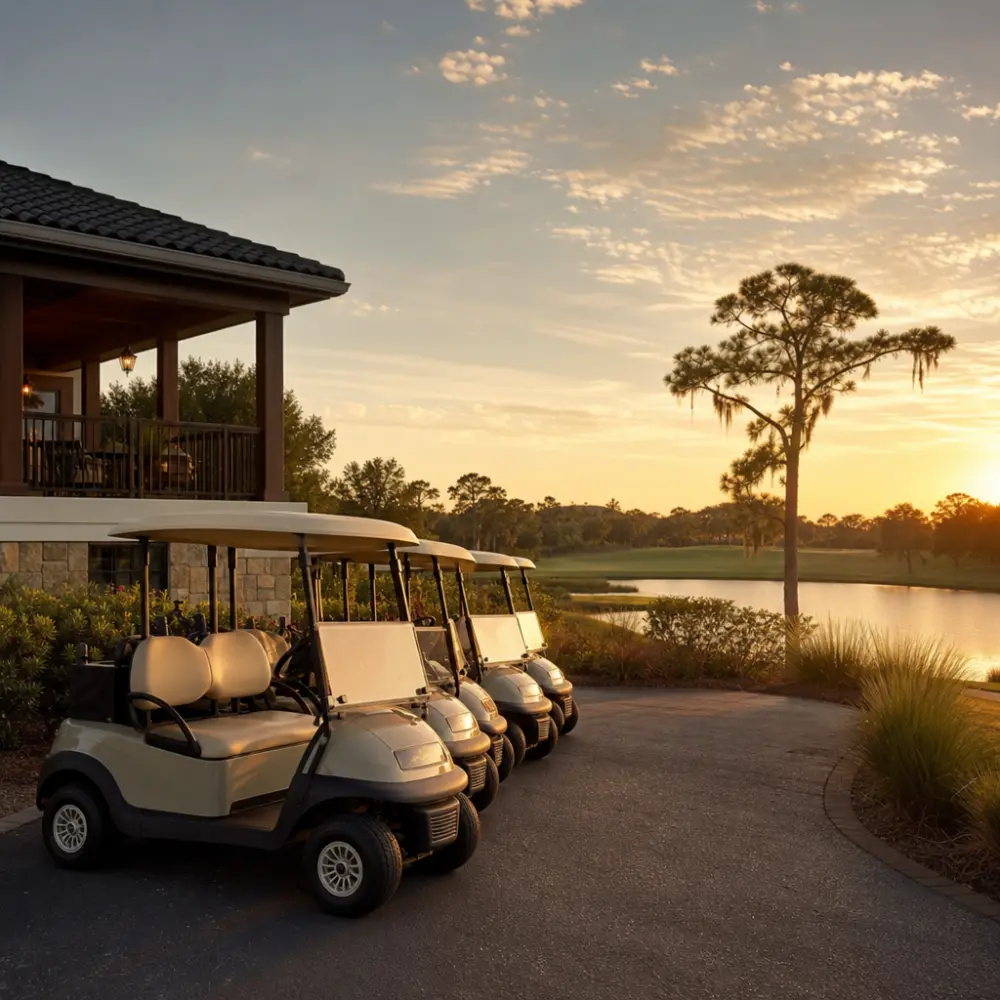
Lake Ashton, a gated 55-plus community about six miles south of downtown Winter Haven off US 27, is the center of gravity for daily cart use in our area: roughly 1,600 homes around two 18-hole golf courses, a 26,000-square-foot clubhouse, and a 30,000-square-foot fitness center that residents reach by cart as often as by car.
Auburndale, west toward Lakeland, and Lake Alfred, home to the University of Florida’s oldest off-campus research center, both sit inside the same lake-and-citrus belt Winter Haven does. Eagle Lake, just south on US 17, and Haines City and Davenport to the east, toward the fast-growing Highway 27 corridor, round out the close-in towns. Bartow, the Polk County seat, and Lake Wales, up on the sandy Lake Wales Ridge, are the two furthest stops on the route.
How a mobile visit works
- Tell us the symptom. Will not move, clicks but no go, will not charge, sags coming back from the lake, squeals when braking. Most problems narrow down fast from a good description, so the tech arrives with the likely parts.
- We come to you. Driveway, garage, or cart barn, at a scheduled window. The $50 to $100 trip fee includes the diagnostic and gets applied to the repair.
- We diagnose before we recommend. Load test on each battery, voltage checks across the pack, charger output test, voltage drop along the main cables, solenoid and controller checks. We isolate the actual fault instead of selling the most expensive maybe.
- Flat quote on the spot, fix on the spot. Battery sets, solenoids, brake shoes, and tires are usually on the truck. Approve the number and most jobs are done in that same visit.
- Finish clean. Lead-acid packs get watered and terminals cleaned and coated, everything gets a torque check and a test drive, and old batteries leave with us for recycling.
Straight answers, published prices
Two things we will not do. We will not pretend to be something we are not: we are an independent service, not an authorized dealer or warranty center for Club Car, E-Z-GO, Yamaha, ICON, or Evolution. If your cart is under factory warranty, your selling dealer should handle warranty work. And we will not sell parts you do not need. A cart that will not charge gets a charger and charge-port test before anyone talks about a battery pack, and a weak cart gets a per-battery load test before we condemn six batteries when one is the problem. If a repair does not make sense against the value of an old cart, we will say that too.
The work is done by experienced, insured local golf cart technicians. More on how we operate is on the about page, and the FAQ answers the questions we hear most.
Get a fast quote
A lot of owners land here after typing “golf cart repair near me” with a cart that will not leave the garage. That is exactly the call this service was built for. Tell us the brand, model year if you know it, whether it is a 36V or 48V electric or a gas cart, and what it is doing. A photo of the battery compartment or dash helps. We will come back fast with a flat number and a scheduling window, and in most cases we can reach you same-day or next-day anywhere from Lake Ashton to downtown Winter Haven to Bartow.